This is the first of a 15 part series of Month of Mindfulness posts.
Anxiety underlies many of the mindset issues we face. In this post I’ll share 7 ideas to help you reduce that anxiety and improve your career, relationships, health or whatever is your main problem.
I think it’s safe to say that just about everyone feels anxiety to some degree or other. First of all, it is perfectly normal to feel anxious. It is our body’s way of protecting us from danger, and in acute circumstances is helpful. The problem is when we are feeling anxious for an extended period of time.
I won’t go into a detailed description of anxiety and its effect on body and mind, as that could take a whole book in itself. If you want a more in depth understanding of the effects of anxiety, I recommend listening to the Feel Better Live More podcast by Dr Rangan Chatterjee and search for anxiety. There are several excellent episodes.
I will breathe. I will think of solutions, I will not let my worry control me. I will not let my stress level break me. I will simply breathe. And it will be okay.
Shayne McClendon
1. Breathe
One of the first things you can do to calm yourself down is to slow your breathing. Sit quietly if you can and just take a long slow breath through your nose. Feel your abdomen swell as you take in a deep breath. Hold it for a moment and then breathe out slowly and fully through your nose. A lot of people will say to exhale through your mouth, but I prefer through the nose. Use what works for you. Repeat this three times.
You can also do some box breathing. Start with breathing in for the count of four, hold for four, out for four, hold for four and repeat. You can adjust the count to suit you. I like to exhale for a little longer than the inhale.
Or you could simply become conscious of and follow your breath. You can count your breaths or just say in, out, as you inhale and exhale.
These techniques are helpful when you are feeling acutely anxious, and I recommend a regular breathwork practice to enable you to cope better with situations that cause you anxiety in the long term.
2. Exercise
Get of the house and have a brisk walk. Go to the gym and do a strenuous workout. Dance and shake it out. Do anything to burn up some of the anxious energy. Some people find physical work helps. Declutter a room or clean your windows. Dig the garden or rearrange a room. Anything that takes physical exertion and occupies your mind is good.
Keep mindful, whatever you are doing. Focus on your chosen activity
3. Improve Your Sleep
A lack of sleep, or lack of good quality sleep, is a real risk factor for anxiety.
One of the best things you can do to aid your sleep is to stick to a routine. Go to bed at the same time every night, and get up at the same time every morning. Try to ensure you get between 7 and 9 hours sleep per night, as the NHS recommend.
The best bridge between despair and hope is a good night’s sleep.
– E. Joseph Cossman
Turn off all of your screens at least an hour before your scheduled bed time. This includes tv, laptop, tablet, phone and games consoles. Don’t listen to news in the few hours before bed. Especially in times of crisis it can be deeply troubling and interfere with your sleep and your dreams, as your subconscious mind will be troubled.
Listening to a guided mindfulness meditation before bed can help to settle your mind a you will fall asleep focused on positivity.
If you have a lot of things you need to do and it’s making you feel anxious,, write them down before bed. This can help to stop worry, and your subconscious mind will be working on things while you sleep. You may find you wake up knowing just what you need to do and get things checked off your list very quickly.
Taking just a few minutes to do this before bed can greatly help to reduce your anxiety, and can help you to sleep better too.
4. Alcohol
A lot of people have a drink to ‘settle my nerves’, but in fact it does the opposite. Alcohol actually causes anxiety. So although in the very short term you may feel better for having that drink, long term you are adding to your anxiety.
I would say that 90% of my own anxiety disappeared when I stopped drinking.
If you want to drink, try to do so mindfully. Pay attention to how the alcohol tastes. Try and notice how your responses change after each drink. Ask yourself if you really need another one rather than just mindlessly reaching for the bottle again. Just taking a pause can help.
Journal how you feel when you are drinking. You may be surprised how your writing changes after the first drink, then second or third.
5. Gratitude Journal
Writing in a gratitude journal before bed can help us to realise that we have a lot to be grateful for. This becomes especially significant at times of stress and anxiety.
There is always good in our life, however difficult the circumstances may be. Try to think of at least 3 things that you are grateful for. Attempt to come up with different things each day, or go in to different details. For example, rather than writing ‘I am grateful for my family’, pick a different member each time, and something about them you are grateful for. Try to do this as mindfully as possible to get the full benefit.
By doing this, you are going to bed thinking in a positive way, and it is very likely you will then wake up feeling positive too.
6. Journaling
Journaling can be a great help in relieving anxiety. Some of the psychological benefits of journaling are:
encourages positive thinking
helps release negative emotions
helps boost mood
enhances sense of wellbeing
helps identify cause of stress and anxiety
helps reduce depressive symptoms
A nice journal and a good pen can make the journaling process more enjoyable, but any paper and pen will do. Try not to use a computer to journal. Studies have shown actually handwriting can be more beneficial.
Set a time each day when you are going to journal. First thing of a morning is a good time, as we are still not fully conscious and can more easily access our subconscious mind. If you set a regular time you are more likely to make it a habit. Set a reminder on your phone if you would like a nudge.
There are many ways to journal, but a good way to get started is just to write whatever comes to mind for three pages. If you can’t think what to write, you could use a prompt, such as ‘how am I feeling today?’
If nothing comes to mind, just write that down until something comes. Once you get started, words will start to flow.
Getting things down onto paper can help us to stop worrying about them. This will also allow you to see what is playing on your mind. You can change what can be changed, and let go of what you cannot change.
7. Meditate
Meditation
If you regularly meditate, you may wish to increase the amount of meditation you do. If you have never meditated before, you could start with a short guided meditation. I have a couple of free meditations you can download on my home page. You will also find an introduction to Journaling PDF and a Mindfuless Resources Guide there. Also if you search on YouTube you will find lots of free meditations to help with anxiety.
Don’t forget, this is the first of 15 mindfulness related posts over the next month, so keep checking back.
These 7 motivational quotes about mindfulness can be a good way to focus your mind on the present moment. As you make each moment the best it can be, the future, as it unfolds also becomes the best it can be.
Here are 7 of my favourite motivational mindfulness quotes.
Enjoy!
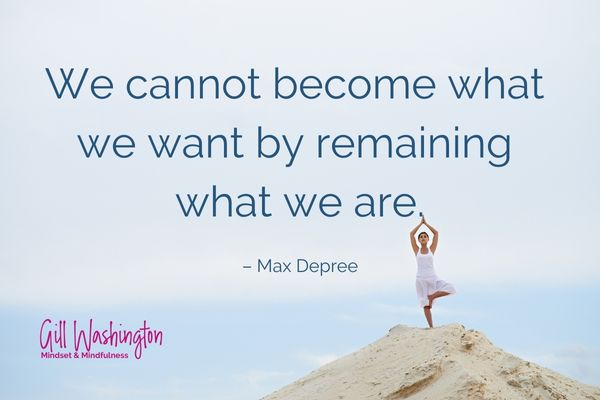
We cannot become what we want by remaining what we are.
– Max Depree
If we want something different to what we have now, then we have to be prepared to make changes.
You are the sky. Everything else is just the weather.
– Pema Chodron
Identify with the sky, not the weather. That is, don’t identify with what is always subject to change, but recognise yourself as that which never changes.
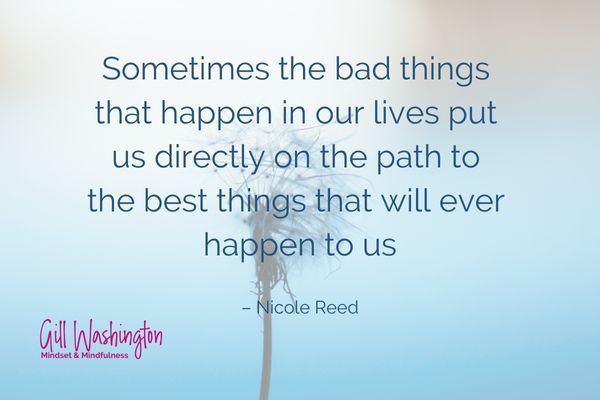
Sometimes the bad things that happen in our lives put us directly on the path to the best things that will ever happen to us.
– Nicole Reed
This is not to discount that bad things do happen, but to accept that what may seem unbearable could turn out to be the best thing to ever happen. Always keep a look out for opportunities that may pass by if you are too busy looking at the past.
Mindfulness is a pause – the space between stimulus and response: that’s where choice lies.
– Tara Brach
This was one of my earliest mindfulness lessons. The recognition that I did not need to react from ego, but could just pause, see what reactions I was having and then try to respond mindfully. It was life changing for me. Try it and see how it works for you.
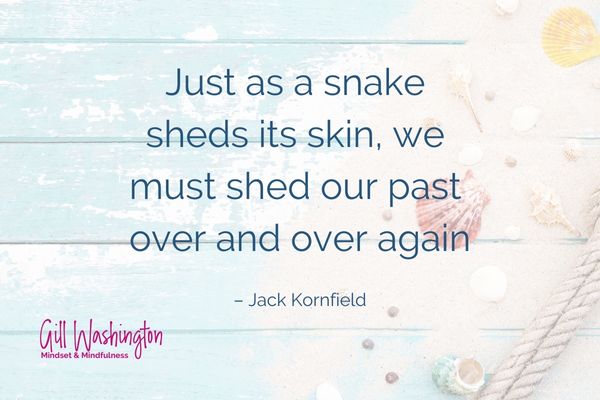
Just as a snake sheds its skin, we must shed our past over and over again.
– Jack Kornfield
The past is a heavy weight we often carry around with us. Try lessening your load, stone by stone if you have to, and take the load off your shoulders.
Live life as if everything is rigged in your favor.
– Rumi
What is the best thing that could happen in any situation? How often do you ask yourself that? So often we go to the worst case scenario, and so often that never happens. If you find yourself feeling that everything is doom and gloom, just ask yourself what is the best that could happen, and live that possibility.
Because you are alive, everything is possible.
– Thich Nhat Hanh
You’re alive, life is a blessing. Make what you want to happen a real possibility.
Maintaining regular mindfulness practice has many benefits and I want to share some ideas to help you maintain that practice.
Doing even a few minutes of mindfulness practice each day can have many benefits. Listed below are some easy ways to remind yourself to practice regularly:
Setting a regular time each day means you will be more likely to practice.
Set an alarm (a mindfulness bell) on your phone to wake you up a few minutes early each day and practice then. I have a collection of morning meditations to listen to, but my favourite go to is to just follow my breath.
Do a Mindfulness Meditation for a few minutes each evening before you go to sleep. Again, I like to just follow my breath, but you can find guided meditations online.
Do one thing at a time and totally focus on that. Concentration can be difficult when there seems to be a million things urgently needing attention, but this regular focus can help to improve this.
Look at your to do list and decide what is the most important thing you need to do right now. Start work on it, and don’t let yourself be distracted by anything else until it is done. Large tasks will need to be chunked down into smaller steps. If necessary, turn off your phone and any other distractions, such as email and social media notifications.
Come Back To The Present Moment
If you find yourself stressed, anxious, frustrated or ‘creating a story’, just come back to the present moment, even if just for three deep breaths .
Try to be present in all your interactions with others – really listen to the other person. Listening to someone without waiting to jump in and speak is a real gift. With clients, it can help you to understand them and their problems so much more. With colleagues and employees it can help you to understand things from their perspective.
Use cards such as oracle cards, choose one daily and meditate on that throughout the day. Write some affirmations related to your business goals and focus on them whenever you can.
Be open minded and flexible – if you miss a day (or more) then do what you do when you find your mind has wandered during a meditation, just bring yourself back to practice.
Be kind and non-judgmental with both yourself and others.
Make sure you are comfortable. You do not need to be sat cross legged on the floor. Sit on an upright chair, using cushions if necessary to keep you straight and comfortable. Or you can lie on your bed or the floor. It is all about what works best for you.
Remembering Mindfulness Practice
“Mindfulness isn’t difficult, we just need to remember to do it.”
Sharon Salzberg
You may think the aim of mindfulness is to get rid of your thoughts, but that is a virtually impossible task. The aim of practice is to focus on one thing, usually the breath, and just keep coming back to it again and again when realising the mind has wandered off.
Moment-By-Moment Awareness
This helps to develop the moment-by-moment awareness you are looking for. You will also probably find your thoughts lessen, but don’t make this a goal of your practice. It is probably the number one reason people give up and think they ‘can’t meditate’.
There are many mindfulness meditations available online. Try YouTube to start. I have a 3 Minute Breathing Space Meditation you can download free. It’s a really good one to get you started, but also useful for more experienced meditators.
I also have a Mindfulness For Busy People Course . This is a short 21 day course, and each day you will receive a practical tip for developing your practice, without using up hours of your precious time. Read more here.
Mindfulness is simply being aware of what is happening right now without wishing it were different; enjoying the pleasant without holding on when it changes (which it will); being with the unpleasant without fearing it will always be this way (which it won’t).
James Baraz
Best Gift
One of the best gifts you could give to yourself is mindfulness.
In Summary
I hope this has given you the information need to begin a mindfulness practice. Take your time, enjoy the process, be as aware as you can be. If it helps, journal when you begin your journey and note any changes. Always be kind to yourself – there is no wrong way to practice.
Benefits of mindfulness are many, and I’ll look at a few below. You don’t have to meditate for hours a day, or do other convoluted practices. Just start with a few minutes meditation and start to really pay attention.
Improves Overall Wellbeing
A regular Mindfulness practice will lead to a more balanced life. You will enjoy pleasurable times and moments more, as you will be more aware of them. You will also be able to deal with adverse situations in a much healthier way, rather than reacting from ego.
Regular meditators also tend to worry less about the future, and regret the past less, as they focus on the present moment.
Improves Physical Health
A regular meditation practice can lead to lower stress levels, lower blood pressure, reduce chronic pain, aid sleep, and alleviate digestive difficulties. Even just a few minutes per day can have a profound effect.
Improves Mental Health
Anxiety, stress, depression, exhaustion, overwhelm and irritability all decrease as a result of a regular mindfulness practice. Just give it a go and see for yourself.
Helps With Better Sleep Quality and Quantity
By reducing stress and anxiety, you can get a deeper, longer and more restful sleep. This will benefit just about every area of your life.
Aids Weight Loss
As you become more aware, you will pay more attention to what you are putting into your body. You are much less likely to mindlessly eat junk food. Consequently this awareness will lead you to chew more slowly and be aware of when you are full and stop eating.
Aids Clear Thinking And Productivity
You will find yourself being able to think more strategically, so having more ideas and solving problems more efficiently.
Aids Better Relationships
You will find your relationships will improve. Your family, friends and colleagues will consequently become easier to deal with as you will have more compassion, patience and understanding. As a result, it’s very likely this will also lead to a change in their behaviour and their relating to you. They may even ask you how you have changed.
These are just some of the benefits of Mindfulness . Try to observe some ways in which your life, work and relationships improve as you begin to practice regularly.
Journaling can help you to keep track of your thoughts and feelings and document ways in which you have managed to improve your life.
Beginner’s mind is both simple and beautiful. It’s where we start, and where we want to return to. Moment by moment, experience by experience.
If your mind is empty, it is always ready for anything, it is open to everything. In the beginner’s mind there are many possibilities, but in the expert’s mind there are few.
– Shunryu Suzuki
Very often we approach situations with our conditioned mind. This conditioning is often unconscious. We have unwittingly taken on the views of our parents, peers, teachers, colleagues, church and wider community. Very often this conditioning goes unquestioned.
In beginner’s mind, we approach everything as if for the first time. Just seeing everything as it is, without the weight of conditioning.
Freeing yourself of this conditioning takes work, but is absolutely worth it.
Continuity of Mindfulness
An important part of being mindful is to get through the difficult times we all face and maintain some continuity of mindfulness. To achieve mindfulness (beginner’s mind) is not difficult, and it can be maintained by those who practice regularly a lot of the time. Sometimes, in some crucial moments, it is extremely difficult. How you handle these difficulties and challenges is most significant. It is the continuity of mindfulness that is crucial. It is this continuity that we are developing with practice.
We could say, therefore, that by focusing our attention on the present moment, calmly and mindfully accepting our thoughts, feelings and bodily sensations, we achieve a mental state that can be used to therapeutic effect. It is important to remain detached and non-judgmental, including of ourselves.
Just Observe
Just observe, practice noticing little sensations before you react and use them as a mindfulness bell to help you to respond to a situation rather than react (egoically) to it.
For instance, if someone is critical of you in an online review, or in a response to a post you have made, you can rant back at them mindlessly (I have been guilty of this in times gone by), or you can decide to calmly look at the situation and respond mindfully. Or decide to ignore it.
Perhaps some of their criticism is valid, in which case thank them and move on.
If they are trolling you, either delete and move on, or respond calmly, knowing that their response is about them and not about you.
It can be easy to get wound up thinking that their comments could harm your business, but this is highly unlikely with a one of comment. These people usually give themselves away as trolls, and your audience is not easily fooled. Have faith in them.
This practice can be applied to all areas of life – home, work, social settings.
Again and again, examine Every aspect of your mental and physical activities. In brief, that is the very way of observing mindfulness.
– Shantideva
Paying Attention
Mindfulness can help us to pay attention in everything that we do. By practicing meditation, we can learn to become more and more aware of things going on around us such as the birds singing, the wind in our hair or the sun on our skin. We may notice things we have walked past for years and overlooked.
In your work or business you may find that ideas flow much more clearly, and problems are more easily solved. You may pick up on potential problems before they happen, saving a lot of time, money or overwhelm.
In your relationships, you may find that you are more tolerant and understanding. And your calmer nature will likely rub off on your friends, spouse or colleagues too.
If you have never meditated before, mindfulness meditation can be a nice, simple introduction to the practice. And if you are a seasoned meditator, you can always work on deepening your practice.
Free Downloads
I have a couple of short meditations mp3s you can download for free:
Mindfulness is a way of befriending ourselves and our experience.
Jon Kabat-Zinn
Being Focused
I was first introduced to mindfulness formally in 1996. I came to realise, however, that I had been practicing mindfulness for most of my life, without realising it. Just by paying attention to everyday things, my yoga practice and the meditations that followed a session. Focusing on reading and not being disturbed by anything around me. Just being in the present moment.
Ongoing Moment to Moment Awareness
Soon after this formal introduction, I came to practice more and more. Then, I came to understand that mindfulness is not just sitting down and doing a twenty minute meditation each day, or performing a body scan to release tension, but is an ongoing, moment to moment awareness.
Try to just practice this as much as you can, gently bringing yourself back every time you realise you have lost awareness.
We use cookies on our website to give you the most relevant experience by remembering your preferences and repeat visits. By clicking “Accept All”, you consent to the use of ALL the cookies. However, you may visit "Cookie Settings" to provide a controlled consent.
This website uses cookies to improve your experience while you navigate through the website. Out of these, the cookies that are categorized as necessary are stored on your browser as they are essential for the working of basic functionalities of the website. We also use third-party cookies that help us analyze and understand how you use this website. These cookies will be stored in your browser only with your consent. You also have the option to opt-out of these cookies. But opting out of some of these cookies may affect your browsing experience.
Necessary cookies are absolutely essential for the website to function properly. These cookies ensure basic functionalities and security features of the website, anonymously.
Cookie
Duration
Description
cookielawinfo-checkbox-analytics
11 months
This cookie is set by GDPR Cookie Consent plugin. The cookie is used to store the user consent for the cookies in the category "Analytics".
cookielawinfo-checkbox-functional
11 months
The cookie is set by GDPR cookie consent to record the user consent for the cookies in the category "Functional".
cookielawinfo-checkbox-necessary
11 months
This cookie is set by GDPR Cookie Consent plugin. The cookies is used to store the user consent for the cookies in the category "Necessary".
cookielawinfo-checkbox-others
11 months
This cookie is set by GDPR Cookie Consent plugin. The cookie is used to store the user consent for the cookies in the category "Other.
cookielawinfo-checkbox-performance
11 months
This cookie is set by GDPR Cookie Consent plugin. The cookie is used to store the user consent for the cookies in the category "Performance".
viewed_cookie_policy
11 months
The cookie is set by the GDPR Cookie Consent plugin and is used to store whether or not user has consented to the use of cookies. It does not store any personal data.
Functional cookies help to perform certain functionalities like sharing the content of the website on social media platforms, collect feedbacks, and other third-party features.
Performance cookies are used to understand and analyze the key performance indexes of the website which helps in delivering a better user experience for the visitors.
Analytical cookies are used to understand how visitors interact with the website. These cookies help provide information on metrics the number of visitors, bounce rate, traffic source, etc.
Advertisement cookies are used to provide visitors with relevant ads and marketing campaigns. These cookies track visitors across websites and collect information to provide customized ads.







Recent Comments