by Gill Washington | Oct 10, 2022 | Mental Health, Mindset
Today – 10th October 2022 – is World Mental Health Day, and I wanted to share something to raise awareness. Taking care of mental health is something we can all take the time to do, regardless of how we are feeling.
I have struggled with anxiety and depression for a long time, and my mental health is something I work at every day, to keep myself feeling as good as possible.
Over the decades, I have built up a toolkit of ways to keep depression and anxiety at bay, and these are some of the ways I do it:
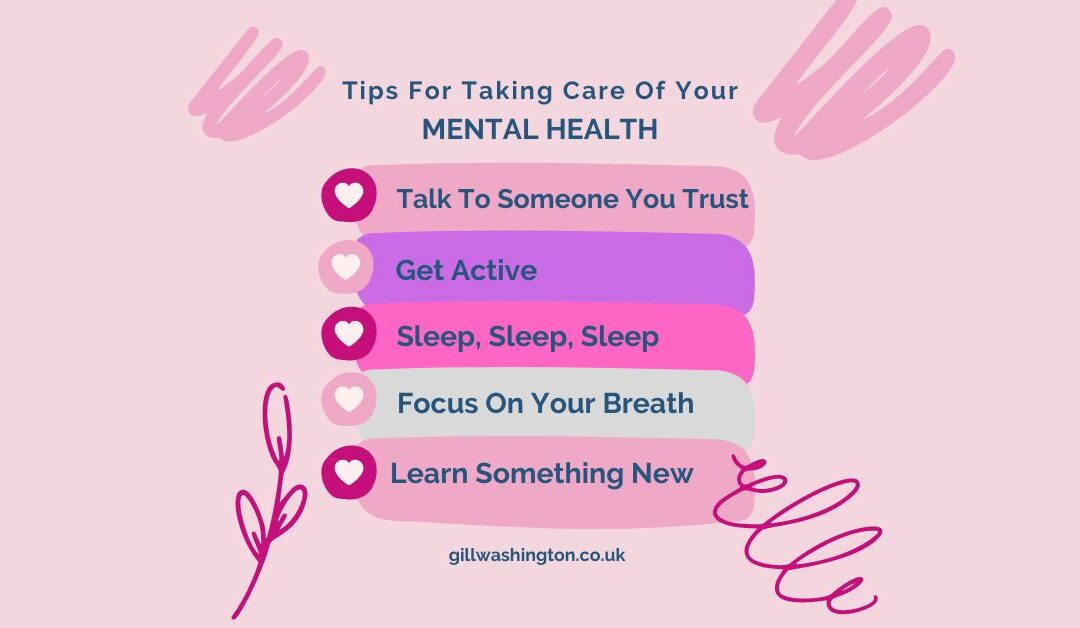
Talk To Someone You Trust
This is the most important point. And if you really feel like you can’t do anything else, talk to someone today. You will be surprised how many people will be willing to listen, and sometimes that is all that is needed. A problem shared really can be a problem halved and there are so many people who can help.
Get Active
If at all possible, get up and move your body. If you can, get outside and get some fresh air. Go for a walk in the woods or a local park. Walk along the beach and breathe in the salt air. Run if you can or do an aerobics class. If you can’t get outside, at least open a window.
Regular exercise will help you think more clearly, reduce stress and improve your sleep.
These will all have a significant effect on your mood.
Sleep, Sleep, Sleep
The importance of sleep for your mental health cannot be overemphasised. It needs to be good quality and sufficient quantity. Unfortunately, sleep is very often disturbed by poor mental health. There are steps you can take to improve your sleep, and you will quickly notice a shift in your mood when sleep improves.
Don’t stress about numbers or think you absolutely must get eight hours. That is likely to keep you awake. Instead, work at trying to get just a few minutes more sleep each night, until seven or eight hours becomes the norm.
Check out this blog post if you would like to know how mindfulness can help with sleep:
gillwashington.co.uk/can-mindfulness-help-with-sleep/
Focus On Your Breath
This is my go-to whenever things get stressful, or if I find myself ruminating on problems. Rather than let the ruminations cause a deflated mood, I do some breathwork.
Three deep breaths is always a good place to start, as is just focusing on your breath. Follow the inhale and exhale and keep all your attention on that. It’s that simple, just remember to keep doing it. There are many ways to work with your breath, and I will do a full blog post about it shortly.
Learn Something New
Learning something new, or restarting something you used to love, can help to focus your mind on the task at hand. Like focusing on the breath, this can prevent rumination. It can also boost your serotonin levels because of the feel good factor when you accomplish something.
You could try learning a craft, a language, learn how to play a musical instrument or how to create graphics for social media.
Something I love to do is jigsaw puzzles. I get so absorbed that all I am thinking about is finding the next piece.
Listen To Others
These are just some of things you can do to look after your mental health. And remember to look out for your loved ones. Just as it’s important for you to talk, be a listening ear for others when they need it too.
Helpful Resources
Some helpful sites if you are struggling:
Mind
Samaritans
Gill Washington does not provide medical advice, diagnosis or treatment. See additional information
by Gill Washington | Sep 28, 2022 | Mindset
The benefits of 4 years alcohol free are many. First, a little about how I managed this milestone.
On 23rd September 2018, I had my last drink. I was going to be 60 on 19th October 2019. I wanted to do a year alcohol free as part of my ’60 before 60′ challenge, but think I knew I really didn’t want to drink again. Ever! And I have now been alcohol free for 4 years.
I used all of the same mindset tools I use with others to stop drinking (and lose weight, that’s a post for another day).
This Time Felt Different
Once I took the decision to stop, it was very easy. I had had periods of being teetotal previously. During my pregnancies I didn’t drink, although they were a long time ago. I often took a week off, regularly did dry January and abstained during Lent. I had also taken 3 months off a few times. But this time felt different.
In 2016 I had taken 3 months off drinking completely. With a 28lbs weight loss I looked and felt great. And then followed various problems, during which my dad died suddenly. I drank pretty much every night for a year. The weight piled back on and I looked and felt awful.
12 Month Challenge
I knew I just didn’t want to carry on like that. And so I set myself the challenge of 12 months alcohol free. I announced it publicly on Facebook and Instagram, as an added accountability check.
Prior to stopping, I had listened to, and read, quite a few books. Some of the best were:
- Allen Carr’s Easy Way to Control Alcohol
- This Naked Mind by Annie Grace
- The Unexpected Joy of Being Sober by Catherine Gray
- Emotional Sobriety by Tian Dayton
- The Sober Diaries by Clare pooley
- Mrs D Is Going Without
There were others, but the list above were the ones I found most helpful.
As well as reading, I listened to self hypnosis videos on YouTube and followed sober accounts on social media. I would fall asleep listening to a book or self hypnosis. I also joined Janey Lee Grace’s The Sober Club membership. I also journaled about how I was feeling, and that was a great help.
No Redeeming Features
All in all, I just came to deeply understand that alcohol actually had no redeeming features at all. My life would be much better off without it. When I started off, I didn’t know if I would be able to manage a full year. What about Christmas, parties, birthdays, holidays?
The Obstacle Is The Way
As it turned out, these ‘obstacles’ all came about quite quickly. On my birthday I hadn’t yet reached 1 month alcohol free, and the following day my sister held a party – a reunion for cousins on my mum’s side. The wine flowed copiously, but I didn’t find it difficult. I had made my decision and just didn’t have any inclination to drink. At the end of the night, I drove myself home safely. No having to wait for a taxi, nor having to pay for one.
Eight days after the party it was my grandson George’s christening, and the next day I went on a 10 day cruise around the Norwegian coast with my cousin Liz. I was glad I wasn’t drinking because the price of wine on the boat was astronomical!
And of course, less than two months later it was Christmas with all of the usual celebrating. These obstacles became the way, to borrow a phrase from Marcus Aurelius. I navigated the way with ease, and entered 2019 knowing I could not only do this, but would enjoy doing it.
The Benefits Of 4 Years Alcohol Free
So, what are the benefits of 4 years alcohol free? These will vary from person to person, but here are some that I have enjoyed.
Better Sleep
Many people speak about how nice it is to wake up hangover free and feeling rested and ready for the new day. That’s true for me too. Yet even more enjoyable is getting into bed fully conscious. I love to do a few gentle yoga stretches, read a book, do some colouring and/or listen to an audiobook or a YouTube video.
It’s also true that alcohol induced sleep is much poorer quality. And there’s no waking up at 3am desperate for a glass of water when you’re teetotal.
Now, I go to bed earlier, I fall asleep easily and consciously, and I average between 6 and 7 hours per night, and hit all of my benchmarks as per Fitbit. Some nights I get 8 hours or more, and am always excited about that.
Weight Loss
To be honest, weight loss took quite a while for me. That’s because I developed a raging sugar addiction when I stopped drinking alcohol. That habit was harder to break than stopping drinking, and I will write another post about that.
In the last 12 months I have lost nearly 3 stone (42lbs or 19kilos). The weight has come off slowly but surely, and would have been a lot harder if I had been adding in empty calories from alcohol.
I still have a way to go, but know now I can do it. If you’re finding it difficult to shed the pounds, definitely take a look at how much alcohol you are consuming.
Not only does alcohol contain lots of empty calories, but it lessens our willpower, and you may find yourself reaching for a bag of crisps or a takeaway during or after a drinking session.
Improved Mood
Depression has been something I’ve struggled with for many years. Since cutting out alcohol, however, my mood has been much improved. There are lots of factors involved, and although I wouldn’t say it is solely down to quitting alcohol, it’s certainly helped. There’s the weight loss and the better sleep, but they are down to quitting alcohol anyway.
If your mood is low, or you are on antidepressants and they’re not working, consider taking a break from the booze for a while and see if it makes a difference. Alcohol is a depressant after all. Don’t stop taking any medication without chatting to your doctor though.
Improved Concentration
I definitely have better concentration and improved memory since I stopped drinking, and even more so since I drastically cut the amount of sugar in my diet. That could be from not ingesting alcohol regularly, and also from getting much better sleep.
I have a longer attention span when reading or watching tv or studying than I did when I was drinking.
Better Overall Wellbeing
Some other benefits include reduced blood pressure, lower blood sugar levels, improvement in digestive issues and problems such as headaches, heartburn and indigestion.
You are likely to have a much better nutritional balance and increased energy.
Much Improved Finances
According to the app I set up on my phone when I stopped drinking, I have saved almost £22,000.00. That’s staggering. When we are spending the money in dribs and drabs we don’t notice it so much, but if you start to add it all up, you realise what a waste it all is.
There’s not just the money for the alcohol, there’s forking out for taxis to get home. And the petrol to go and collect your phone the next day because you left it in the taxi (that happened to me several times).
Imagine what you could do with that money if you put it into a savings account each day rather than buying booze. I wish I had been disciplined enough to do that. Give it a go, and let me know if you do it.
The Only Downside
The only downside for me was a massively increased consumption of sweet things – fruit and nut muesli for breakfast, biscuits, chocolate and cake throughout the day. This was despite the fact that I knew sugar dependence often happened after giving up alcohol.
If you do decide to take a break from the booze, try to be really aware of this, and get help if you need it. I found that if I ate plenty of fruit (natural sugars) the craving for the sweets disappeared.
Book A Discovery Call
All in all, cutting alcohol out of my life is absolutely one of the best decisions I ever made.
If you feel you’re drinking a little too much and would like to cut back or cut alcohol out for a while, book a discovery call with me to see how I can help. It is a relaxed, no obligation chat and you can find out how my mindset and mindfulness mentoring can help you to change your relationship with alcohol.
Making any change to habits begins (and ends) with mindset. I created a mindset of knowing alcohol was something I didn’t want in my life. I use tools such as reading. listening, affirmations, self-hypnosis, deep-dive journaling and meditation to help you create your desired habit change.
Just a note – I help ‘grey area drinkers’ who feel they are drinking a bit too often or a little too much. If you have a more serious problem with alcohol, it’s important to talk to someone who can get you help such as your GP.
Gill Washington does not provide medical advice, diagnosis or treatment. See additional information
by Gill Washington | Sep 4, 2022 | Mindfulness Practice, Mindset
Are You Your Own Worst Critic?
Quieten your inner critic and begin to live a happier, more successful life.
Do you have a little voice in your head, constantly telling you that you are not good enough, nobody will want to read or buy your work, you’re too old or too young, or a million other negative jibes?
If you do, you are in good company. Most of us have this nagging little voice from time to time, and for some it can be an almost constant companion. The good news is you can learn to silence this annoying critic and develop an encouraging, friendly and positive voice in its place.
Everyone has that inner voice, the one that’s a Negative Nancy. I’d say to ignore that voice and to be confident and follow your heart.
– Katharine McPhee
Become Aware
The first thing to do is to become aware of the critic. Start to listen to the thoughts that run through your head. Sometimes it is just there in the background. Like an annoying noise we don’t notice until it stops, it is constantly feeding us negativity. And when we silence it, everything becomes clearer and we can develop self confidence and self belief.
Your Journal Is Your Friend
You can use journaling to note down the negative thoughts, and watch for patterns. What thoughts are constantly running through your head? Which ones do you repeat over and over? Whose voice are they in? Maybe it’s your own voice, or the voice of an overly critical parent or old school teacher. Perhaps a boss who was always on at you. Write it all down, and get familiar with it.
Quieten Your Inner Critic And Turn It Around
Use affirmations that you create by turning the negative thoughts into positive ones. Now that you are aware of what is happening, you can start to change it. ‘I’m too old’ becomes ‘you’re never too old’, ‘nobody would want to read this’ becomes ‘there are people this would really help’. Every time you find the old self criticism pop up, just repeat your positive affirmation. This will soon become your new way of thinking.
Women need to shift from thinking, ‘I’m not ready to do that,’ to thinking, ‘I want to do that, and I’ll learn by doing it.’
– Sheryl Sandberg
Be Kind To Yourself
Really practice being kind to yourself. Would you talk to your child, a colleague or a friend that way? Treat yourself as kindly as you treat others. If you notice negative thoughts, picture yourself in conversation with your best friend. What would you say to her in the same situation? Learn to speak that way to yourself.
Learn to be kind to yourself. Let your mind free, close your eyes, breathe deeply and remain calm. Life is majestic and meaningful enough.
― Shaa Zainol
Reframe Your Relationship
Your inner critic is well meaning, and trying to keep you safe. It doesn’t want you to fail. You can reframe the relationship and take charge. Let your rational, logical brain take over and take charge. You know what you can do, what you are capable of.
Want to know more about how you can quieten that nagging inner critic? Download my FREE PDF and learn 5 ways to do just that:
Get your FREE copy of 5 Ways To Silence Your Inner Critic PDF
by Gill Washington | Aug 28, 2022 | Mindfulness Practice, Mindset, Spiritual Practice
You Don’t Have To Believe Everything You Think
Many years ago, a mentor said to me, “you don’t have to believe everything you think'” and added, “a lot of the thoughts aren’t yours anyway. You just pick them up out of the ether or from passers-by”. To be honest, I was a bit sceptical. But it is one of those seed ideas that has stuck with me over the years, and I’ve realised it is very true.
How often does a thought just pop into your head, and you have no idea where it came from? I know it happens to me all the time. Becoming more self-aware helps us to realise this.
Meditation and Journaling
Meditation and journaling can help with this. For a few days, try to note down any stray thoughts that seemingly pop up out of nowhere. Do you sometimes think, ‘I could kill him’ or something similar? It’s very unlikely you really want to kill someone, it’s just a thought that enters your head.
How often do you think things such as, I’m so stupid, I’m too old/young, too fat, too thin, too tired, too technologically challenged etc.? You don’t have to believe those thoughts any more than you believe the thought, ‘I could kill him’.
And if you have a thought that you have absolutely no idea where it came from, it’s probably one you’ve picked up from someone else.
All of these thoughts are just stories we tell ourselves. We don’t have to believe them. What can you do about them?
How To Stop Them
The number one thing is to realise that everyone has strange, weird and wonderful thoughts. Sexual fantasies, violent thoughts, negative thoughts. Even happy, fun thoughts.
It’s not possible to stop thoughts, and usually the more we try, the more persistent they are. Acceptance is the key. Buddhists have a practice of labelling the thoughts. You can just try saying, ‘a mind full of thoughts’ and return to your breath.
Replace Negative Thoughts With Positive Ones
If you find you are having lots of negative thoughts, develop a practice of replacing them with positive thoughts. The more you do this, the more your thoughts will naturally become more positive. It will take a while, but eventually you will realise you have become a much more positive person. Repeat the positive thought over and over as you go about your day.
This doesn’t mean negative thoughts are ‘wrong’ or you shouldn’t have them. They are a natural part of life. They are just not the type of thoughts we want to dwell on, if we want a strong, positive mindset.
Technologically Challenged
‘I’m technologically challenged’ is one of the most common phrases I hear people say online. It’s a story lots of people take as a fact. I believe in most cases this is much more of a mindset issue than a technological issue. People get stressed out, tell themselves they can’t do something and it becomes a self fulfilling prophecy. Their stress causes them to have a mind that won’t work efficiently, it goes blank.
When I need to figure out some new technology, I just follow instructions slowly, carefully, step by step. And it’s rare there is something I can’t get done. YouTube is also a great resource, there’s a video for how to do just about anything, explained in detail.
If you find yourself saying you can’t do something because you suck at technology, just try repeating to yourself, ‘I can learn how to do this’. You may find that you’re not as challenged as you thought you were.
This process can be used to overcome pretty much any limiting belief we have. Just know that you can learn how to do it, and can change your language around the problem. I have managed to lose almost 3 stone in weight, and be alcohol free for 4 years next month, by not believing the thoughts that tell me I can’t do it.
Mindfulness For Busy People
Check out my 21 day email course if you would love to start a regular mindfulness practice but don’t know where to start, or feel you are too busy.
Mindfulness For Busy People
by Gill Washington | Jul 31, 2022 | Mindfulness Practice, Mindset
Can mindfulness help with sleep? Why no try it and find out.
This is the sixth of a 15 part series of mindfulness posts. One will be posted every other day for 30 days, so keep checking back.
A very common problem I come across when talking to clients and friends, and when looking at social media, is a chronic lack of sleep. There are frequent references to ‘the 3am club’. This seems to increase as people are over 50, but can affect anyone.
I have myself suffered with insomnia. Having made some adjustments to my lifestyle and bedtime routine I have gone from getting between four and five hours sleep per night to between six and seven hours. Some nights I even mange over eight hours. My average now is seven hours per night, and I feel so much better for it. Mindfulness meditation has been a huge part of this.
Long Term Health And Wellbeing
Sleep is immensely important to our long term health and well being. A lack of sleep can cause many health problems, including anxiety, depression, heart disease, obesity and diabetes. It is therefore extremely important to do all we can to increase the amount and quality of sleep we get if we are not getting the recommended 7 – 9 hours of sleep per night.
How Can Mindfulness Help?
Mindfulness meditation and other mindfulness practices induce a sense of wellbeing and relaxation. When you are stressed and tense, the likelihood is you will find it difficult to fall asleep. Then, when you do get to sleep it is likely to be restless and disturbed. Just 5 minutes of meditation per day can help to bring about a more relaxed state.
Meditation Before Sleep
If I don’t do any other meditation in a day, I always do a few minutes when I first wake up (before I even open my eyes), and last thing at night before going to sleep. These are two really valuable times to meditate. The veil between the conscious and the subconscious mind is lifted, and insights can easily pop up. Agitated thoughts can calm down, and heart rate and blood pressure can lower.
I prefer to just follow my breath for the early morning meditation, as I don’t want to open my eyes or look at my phone and break that wonderful half awake, half asleep, state. If you prefer, or if you find it difficult to just follow your breath, you can listen to a guided meditation.
There is a three minute breathing space meditation you can download for free here.
There are also lots of videos you can listen to on YouTube and other places online. Find a voice that is restful for you. You don’t want an annoying voice disturbing your relaxation. I always listen to a minute or two before downloading.
If you would like to get one to one help from me with your meditation, consider booking a power hour with me. You can read more about how it works here: gillwashington.co.uk/power-hour
During a meditation power hour, as well as working through your pressing issue, we will do some meditation together.
If you’re struggling with getting to sleep, staying or sleep, or poor quality of sleep, why not just try a couple of minutes at the start and end of your day. Keep a journal if possible of any insights and feelings that pop up, and keep going for 21 days. Then compare your thoughts and feelings from day one, with day twenty one. I’m sure you will have noticed an improvement in your sleep, and other areas of your life too.
Mindfulness For Busy People
Check out my 21 day email course Mindfulness For Busy People if you would like to get started with a mindfulness practice but always feel like you don’t have time or don’t know where to start.
Happy Meditating!
Gill Washington does not provide medical advice, diagnosis or treatment. See additional information

by Gill Washington | Jul 21, 2022 | Mindfulness Practice, Mindset, Month Of Mindfulness
What You need To Know About Using Mindfulness To Overcome Depression
This is the second of a 15 part series of mindfulness posts. One will be posted every day for 30 days, so keep checking back.
Over 30 years ago I paid a visit to my GP with a list of health problems. He told me, ‘invariably, when anyone comes with a list they are depressed’. He gave me a prescription for antidepressants and sent me on my way.
I have spent the thirty years since figuring out ways to improve my own mental health, and helping others to do the same. Mindfulness has by far been the most effective way I have improved my mindset. Below I will share some of the things that have helped me.
The Mindful Way Through Depression: Freeing Yourself from Chronic Unhappiness
The Mindful Way Through Depression is a book by Mark Williams, John Teasdale, Zindel Segal and Jon Kabat-Zinn. It helped me a lot in understanding depression and holding it at bay.
The book explores the reasons for depression, and offers useful tools for overcoming the tiresome ruminations that are so often a part of depression. It also comes with a CD of meditations you can use to practice. These can also be downloaded online. Searching on YouTube will bring up related information.
The authors also created The Mindful Way Workbook: An 8-Week Program to Free Yourself from Depression and Emotional Distress. This takes some commitment, but I would definitely recommend it if you are determined to overcome depression.
These two books are also useful if you are someone who helps clients with depression.
How Mindfulness May Change the Brain in Depressed Patients
There is an excellent post in The Harvard Gazette about how a mindfulness practice may change the brain. It details the work of Benjamin Shapero, an instructor in psychiatry at Harvard Medical School (HMS) and a psychologist at Massachusetts General Hospital’s (MGH) Depression Clinical and Research Program and Gaëlle Desbordes, an instructor in radiology at HMS and a neuroscientist at MGH’s Martinos Center for Biomedical Imaging.
“Individual cognitive behavioral therapy is helpful for many people; antidepressant medications help many people. But it’s also the case that many people don’t benefit from them as well. There’s a great need for alternative approaches.”
– Benjamin Shapero
Desbordes performs fMRI’s on patients before and after an eight-week course in mindfulness-based cognitive therapy, or MBCT, to determine the benefits.
Once we know which ingredients are successful, we can do more of that and less, maybe, of the parts that are less effective
– Gaëlle Desbordes
This is interesting work to keep an eye on.
Top 3 Beginner Meditations For Depression
There is another excellent article on mindfulness as a treatment for depression on flowneuroscience.com. This article includes 3 meditations that help with negative thoughts and feelings.
They also offer an app which could be worth a try. I haven’t used the app, but they do say it is 100% free. Let me know how you get on if you use it.
Recommended Mindfulness Practices To Overcome Depression
Below are the techniques I would recommend if you are starting out using mindfulness to overcome depression.
1. Meditation
If you are just starting off, try a three minute breathing space meditation. I have a free one you can download here. You could also use the meditations included with The Mindful Way Through Depression book if you have that. There are also many meditations on YouTube.
Don’t start off with long periods of meditation if you have never meditated before. And stop for a while if you start to feel worse. Trying a local meditation group can be really useful. I find doing a few minutes of following my breath a great help. Try this before opening your eyes each morning, and as you close your eyes to go to sleep each night.
2. Yoga
Yoga is a wonderful way to exercise both body and mind. Just practicing some asanas each day will be helpful, but the more you can incorporate the principles of yoga into your life the more beneficial it will be.
Try to find a local class. This is better than an online class, especially if you are a beginner. You can then practice what you learn at home. It would also be helpful to find a class where the teacher lives yoga as a way of life, rather than just doing a set of exercises.
Just 15 minutes daily practice can help to reduce depressive symptoms.
3. Breathing Exercises
I gave a brief introduction to breathing exercises in the first post in this mindfulness series, How Mindfulness Helps Reduce Anxiety. Your breath is a way you can instantly take your mind of whatever you are ruminating about and just return to the present moment. When you find your mind has wandered off, just gently bring yourself back to your breath.
The importance of using the breath in this way can’t be overstated.
You are where you need to be. Just take a deep breath.
― Lana Parrilla
4. Mindful Walk
Go out for a walk and try to really pay attention to everything you see, feel, smell, and touch. Oh, why not consider leaving your phone at home. or at least put it on silent mode.
Try to keep your head up. So often people walk with their gaze down to the ground, especially when feeling low. Just lifting your head can actually lift your mood.
Walk slowly, and look at everything you pass. Maybe you will notice something you have never noticed before, even if you’ve walked that way for years.
Feel the sun or the rain on your skin. Feel the wind in your hair. Listen to the birds.
Just enjoy what is.
Gill Washington does not provide medical advice, diagnosis or treatment. See additional information


Recent Comments