This is the first of a 15 part series of Month of Mindfulness posts.
Anxiety underlies many of the mindset issues we face. In this post I’ll share 7 ideas to help you reduce that anxiety and improve your career, relationships, health or whatever is your main problem.
I think it’s safe to say that just about everyone feels anxiety to some degree or other. First of all, it is perfectly normal to feel anxious. It is our body’s way of protecting us from danger, and in acute circumstances is helpful. The problem is when we are feeling anxious for an extended period of time.
I won’t go into a detailed description of anxiety and its effect on body and mind, as that could take a whole book in itself. If you want a more in depth understanding of the effects of anxiety, I recommend listening to the Feel Better Live More podcast by Dr Rangan Chatterjee and search for anxiety. There are several excellent episodes.
I will breathe. I will think of solutions, I will not let my worry control me. I will not let my stress level break me. I will simply breathe. And it will be okay.
Shayne McClendon
1. Breathe
One of the first things you can do to calm yourself down is to slow your breathing. Sit quietly if you can and just take a long slow breath through your nose. Feel your abdomen swell as you take in a deep breath. Hold it for a moment and then breathe out slowly and fully through your nose. A lot of people will say to exhale through your mouth, but I prefer through the nose. Use what works for you. Repeat this three times.
You can also do some box breathing. Start with breathing in for the count of four, hold for four, out for four, hold for four and repeat. You can adjust the count to suit you. I like to exhale for a little longer than the inhale.
Or you could simply become conscious of and follow your breath. You can count your breaths or just say in, out, as you inhale and exhale.
These techniques are helpful when you are feeling acutely anxious, and I recommend a regular breathwork practice to enable you to cope better with situations that cause you anxiety in the long term.
2. Exercise
Get of the house and have a brisk walk. Go to the gym and do a strenuous workout. Dance and shake it out. Do anything to burn up some of the anxious energy. Some people find physical work helps. Declutter a room or clean your windows. Dig the garden or rearrange a room. Anything that takes physical exertion and occupies your mind is good.
Keep mindful, whatever you are doing. Focus on your chosen activity
3. Improve Your Sleep
A lack of sleep, or lack of good quality sleep, is a real risk factor for anxiety.
One of the best things you can do to aid your sleep is to stick to a routine. Go to bed at the same time every night, and get up at the same time every morning. Try to ensure you get between 7 and 9 hours sleep per night, as the NHS recommend.
The best bridge between despair and hope is a good night’s sleep.
– E. Joseph Cossman
Turn off all of your screens at least an hour before your scheduled bed time. This includes tv, laptop, tablet, phone and games consoles. Don’t listen to news in the few hours before bed. Especially in times of crisis it can be deeply troubling and interfere with your sleep and your dreams, as your subconscious mind will be troubled.
Listening to a guided mindfulness meditation before bed can help to settle your mind a you will fall asleep focused on positivity.
If you have a lot of things you need to do and it’s making you feel anxious,, write them down before bed. This can help to stop worry, and your subconscious mind will be working on things while you sleep. You may find you wake up knowing just what you need to do and get things checked off your list very quickly.
Taking just a few minutes to do this before bed can greatly help to reduce your anxiety, and can help you to sleep better too.
4. Alcohol
A lot of people have a drink to ‘settle my nerves’, but in fact it does the opposite. Alcohol actually causes anxiety. So although in the very short term you may feel better for having that drink, long term you are adding to your anxiety.
I would say that 90% of my own anxiety disappeared when I stopped drinking.
If you want to drink, try to do so mindfully. Pay attention to how the alcohol tastes. Try and notice how your responses change after each drink. Ask yourself if you really need another one rather than just mindlessly reaching for the bottle again. Just taking a pause can help.
Journal how you feel when you are drinking. You may be surprised how your writing changes after the first drink, then second or third.
5. Gratitude Journal
Writing in a gratitude journal before bed can help us to realise that we have a lot to be grateful for. This becomes especially significant at times of stress and anxiety.
There is always good in our life, however difficult the circumstances may be. Try to think of at least 3 things that you are grateful for. Attempt to come up with different things each day, or go in to different details. For example, rather than writing ‘I am grateful for my family’, pick a different member each time, and something about them you are grateful for. Try to do this as mindfully as possible to get the full benefit.
By doing this, you are going to bed thinking in a positive way, and it is very likely you will then wake up feeling positive too.
6. Journaling
Journaling can be a great help in relieving anxiety. Some of the psychological benefits of journaling are:
encourages positive thinking
helps release negative emotions
helps boost mood
enhances sense of wellbeing
helps identify cause of stress and anxiety
helps reduce depressive symptoms
A nice journal and a good pen can make the journaling process more enjoyable, but any paper and pen will do. Try not to use a computer to journal. Studies have shown actually handwriting can be more beneficial.
Set a time each day when you are going to journal. First thing of a morning is a good time, as we are still not fully conscious and can more easily access our subconscious mind. If you set a regular time you are more likely to make it a habit. Set a reminder on your phone if you would like a nudge.
There are many ways to journal, but a good way to get started is just to write whatever comes to mind for three pages. If you can’t think what to write, you could use a prompt, such as ‘how am I feeling today?’
If nothing comes to mind, just write that down until something comes. Once you get started, words will start to flow.
Getting things down onto paper can help us to stop worrying about them. This will also allow you to see what is playing on your mind. You can change what can be changed, and let go of what you cannot change.
7. Meditate
Meditation
If you regularly meditate, you may wish to increase the amount of meditation you do. If you have never meditated before, you could start with a short guided meditation. I have a couple of free meditations you can download on my home page. You will also find an introduction to Journaling PDF and a Mindfuless Resources Guide there. Also if you search on YouTube you will find lots of free meditations to help with anxiety.
Don’t forget, this is the first of 15 mindfulness related posts over the next month, so keep checking back.
Boost your mindset with simple decluttering methods.
Are you prone to procrastination? Irritated by imposter syndrome? Or perturbed by perfectionism? How tidy is your house? Are your worktops full of clutter and your cupboards full to bursting? Is your desk a mess of papers and books, and your computer groaning under the weight of thousands of mixed up files, unread emails and photos galore? Clutter has a very real affect on mindset and mood. The good news is it can be cleared relatively easily and quickly. And this will boost your mindset enormously.
Tidy House, Tidy Mind
My dad always used to say , ‘tidy house, tidy mind’. I didn’t really understand what he was saying at the time, but have since come to realise exactly what he meant. I have a tendency to let clutter build up, and I have to work to stay on top of it. Because of this, I have found ways to help me stay clutter free and organised.
Clutter is not just physical stuff. It’s old ideas, toxic relationships and bad habits. Clutter is anything that does not support your better self.
Eleanor Brownn
Clearing clutter is about far more than just having a tidy up and donating a few unwanted items to the charity shop. Systematically going through our homes and our minds and getting rid of all unnecessary clutter can have a profound effect on our physical, mental, and emotional wellbeing. It can lead us to a more abundant life as we get rid of blocks and limitations to happiness, success and wealth.
Let’s take one quick example. When you open your front door and walk into your house, what greets you? Is it a mess of coats, shoes, mail etc? If it is, this will affect your mood, even if only subconsciously, every time you enter your house.
Do you tidy and wipe around your kitchen before you go to bed? If you do, your mood is likely to be much better than someone who comes down to a dirty sink with last night’s dishes on the worktop.
Improve Your Sleep
What about your bedroom? If your bedroom is clean, tidy and comfortable, you will get a better night’s sleep than you will if you have to fight your way through the mess on the floor, and throw things off the bed to get into it. And if your living space is clean, tidy, and uncluttered, you will be more able to sit down and relax than you would if there was a mess around you.
Is your desk tidy and organised? If it is, you will be more productive and efficient than if everything is a mess and you must waste time searching for what you are looking for.
Do you mindfully pay attention to your thoughts and beliefs? If your inner critic is constantly chattering in your ear, telling you your not good enough, you can’t succeed, you will never be wealthy and other toxic messages, you can work on clearing this clutter out too.
Even if you think these things don’t bother you, clutter and mess is influencing your subconscious mind and can lead to underlying anxiety and stress. It can also lead to procrastination as you put off work because you can’t face your messy desk or files. Mental clutter can lead to you missing out on opportunities because your inner voice holds you back from taking those chances.
Download my free PDF 5 Ways to Silence Your Inner Critic if you would like to learn more about how to quieten that nagging inner voice and discover your inner cheerleader.
The 80/20 Rule
It is said that on average we wear just 20% of our clothes 80% of the time. The same rule applies to other things we own – books, DVDs, kitchen gadgets. This means that our homes are cluttered with a lot of stuff that we rarely, if ever put to use.
One way to resolve this problem is to get two large boxes. Mark one box 20% and the other 80%. Starting in one room, closet or cupboard, put everything you use pretty much all of the time into the 20% box. Everything that you use rarely or never at all, put into the 80% box.
Your 20% box is filled with items you really want to keep. Now go through your 80% box and decide what you really need (or want) to keep. Only keep things that you really cannot bear to part with from this box. Sort the rest into two piles – to donate or to go to the tip/recycling.
Put your items from the 20% box back in place. Then revisit the things from the 80% box you wish to keep. If there are things that you really want to keep to hand, such as a gadget you use every week or two, make sure that it is in a cupboard out of sight. Don’t have things you only occasionally use cluttering your worktop. If there are things you want to keep but rarely or never use them, think long and hard before storing them in an attic or garage. The likelihood is you will store them and never get them out again. They may as well be gone.
Tale of The Shipping Container
I read a story some time ago. I can’t remember where I read it. It was about a couple who moved to Canada. They took a lot of belongings with them in a shipping container. All the years they were in Canada, the container remained untouched.
After about ten years, they decided to move back to the UK. One of the partners insisted on shipping the container back. The other partner said absolutely not. They got divorced. Try not to be so attached to your untouched clutter.
Clearing clutter—be it physical, mental, emotional, or spiritual—brings about ease and inspires a sense of peace, calm, and
tranquility.
Laurie Buchanan, PhD
Repeat The Process
If you know you won’t use something but don’t feel ready to part with it, put it aside for a few days then come back to it. You may find once you have got into the clutter clearing flow you will be more willing to let things go. Repeat this process throughout each room, cupboard, drawer etc.
f you have gone through your house following the 80/20 rule and clearing some clutter every day, after a couple of weeks pretty much everyone can have a clean and tidy house.
If you haven’t started yet, try just clearing one area and see what effect it has on your mood. I advise starting with the area just inside your front door, so that you don’t get a sinking feeling every time you enter your home. Or try your workspace, or where you sit in your living room.
I guarantee that once you start to get rid of stuff that is literally weighing you down, you will immediately begin to feel better.
Clearing My Office
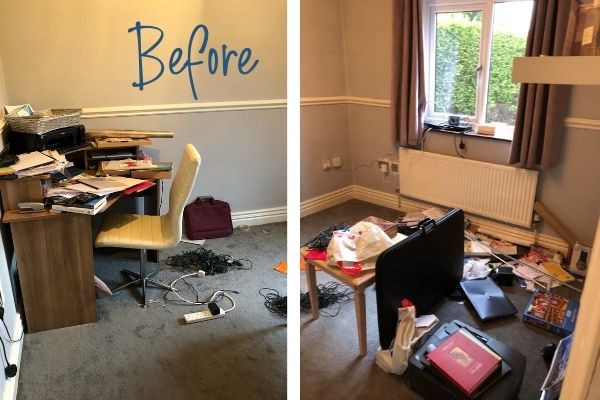
Office Before Decluttering
A few years ago my daughter decided to take over my office as a sitting room. It meant she had somewhere to take friends without having to sit with me or take them up to her bedroom. It meant that I had to work from the dining room table or the settee.
When she moved out, I knew I needed to reclaim the space as my office. A year passed, and I still hadn’t done this. And in the meantime I had been putting everything in there that I didn’t know where else to put. In effect it was a cluttered junk room.
Realising I needed my office and the organisation it would give me, and also knowing the junk was beginning to make me feel down, I set about sorting it out.
As you can see on the photographs, there was quite a bit of junk. I sorted out what was going in the bin/recycling and got that all out of the way immediately. That gave me a lot more space to work. I then sorted what was staying in the room and what was being stored elsewhere.
To get from the initial photos to the photos below took about 2 hours 15 minutes. That was all – and a year after my daughter moved out I had reclaimed my office.
Office After Decluttering
If you don’t have time to do it all in one go, set a timer and do 15 minutes each day. In no time at all you will be sorted.
Boost Your Money Mindset
Many of us carry around a lot of baggage concerning money. Try getting out your journal and write down all of the money related phrases that you have been conditioned to believe since childhood. Some of these phrases are:
Money doesn’t grow on trees
Money is the root of all evil
Filthy lucre
I can’t manage money
I could never be wealthy
Wealthy people are greedy
Wealthy people are ruthless
I could never earn that much money
Money burns a hole in your pocket
Money can’t buy happiness
A fool and his money are soon parted
There are lots of such sayings. You may have heard some of these growing up. You may also have heard others. Write as many down as you can think of. Who’s voice do you hear them in? Is there any truth in them? Can you let them go?
I love Denise Duffield Thomas for all things money mindset. I’m in her Money Bootcamp and have read all of her books, but she has lots of free stuff available on her website if you want to check her out.
I Don’t Have Time To Declutter
Do you think you don’t have time to clear your clutter?
Get started quickly without being overwhelmed:
Set a timer for 15 minutes and just clear as much as you can
Pick one drawer or cupboard and clear it
Walk through your house or office for 10 minutes with a bin bag and grab any rubbish
Spend 15 minutes unsubscribing from newsletters that you never read but are cluttering your inbox
Take 5 minutes and unsubscribe from any Facebook groups you no longer read or are no longer useful
Professional Declutter
If you are overwhelmed with clutter, consider getting someone in to help you. There are home organisers who will go through your house with you and help you to get, and stay, organised. This could save you a lot of time and could be well worth the money. If you can’t afford it, consider asking a well organised friend to help.
Use a VA To Help Boost Your Mindset
If you find yourself procrastinating because your computer files are a mess, consider getting a VA to help you sort it all out. You could use one to just get you organised, or you could employ someone to keep you organised going forward.
You can find VA’s online and you can use them just for the number of hours you need. This can be a small cost that saves you a lot of money.
Emotional Decluttering
Journaling can help with emotional decluttering. Take a good luck at your relationships. Is this an area that needs some work? You may need to work at improving some relationships. It may even be time to end some friendships if they are having a negative affect on your life.
Journaling can also help you to see where boundaries are lacking, and how having them in place can be really useful. Nobody else will be reading your journal, so get really honest there about what needs to change.
Meditation is also a great way to quieten the mind and remove emotional clutter. Try to find even a few minutes a day when you can just sit quietly. Let your thoughts come and go. Don’t worry about them and don’t hold onto them. Just become aware of them.
Have fun with your clutter clearing, and let me know if it helps to boost your mindset.
Social Media – Love it or hate it, it is a big part of our lives. I’m always fascinated when people say they don’t use it. I recently saw a video of actor Cillian Murphy saying he is too old to be on it. He’s about 15 years younger than me, so I must be positively past it, haha.
For the last two months, I have hardly beeon on social media at all. That also meant I got a break from the treadmill of contstant content creation in Canva. It has been both relaxing and enlightening.
I have been posting on social media since before it was really even a thing. And I have been sharing memes since before the word was commonly used to describe images on the internet. In 1997 I created my first website and started a group to go along with it. And ever since then I have been sharing social content pretty much on a daily basis.
Taking A Break
Recently it has become tedious, and I felt had lost its impact. So many people are sharing so much. The joy had gone out of it for me, and I decided to take a break and focus on my own mindset and my mental and physical health. I am so glad that I did.
During this break, I discovered a workshop by Leonie Dawson called Marketing Without Social Media Leonie shares 150 ways to market your business without social media.
This workshop helped me to see I don’t need to be constantly churning out content to grow a successful business. I’m not going to be giving up social media completely, but neither am I going to go back to spending the vast amount of time I was doing previously.
Check it out here. This is an affiliate link, so I will receive a small payment if you purchase the workshop using it. However, I only recommend it because it has helped me enormously and may help you too, even if you are not yet ready to leave social media. At least you will get 150 other marketing ideas.
Warning: Leonie swears a lot, so if you would be offended by that, the course won’t be right for you.
Content Creation and Social Media
I spend a lot of time creating social media content, but to be honest most of my clients come from word of mouth or are returning clients or find me via my website or online directories. The amount of return I get from social media is totally out of line with the amount of time I spend on it, both creating and engaging with others.
I have decided that moving forward I am going to be creating at least one piece of long form content per week, and at the moment this will be a blog post. This is something I have been neglecting because of the time spent on social media. For the moment I will share on Instagram and my Facebook page quotes or snippets from the blog post and direct people there. Concentrating on building my email list is also a priority, which I have been neglecting. I will keep reviewing all of this. It’s possible I may start another group at some point down the line, but first I want to spend some time creating other valuable content.
Personal or Business?
Something I experimented with over the last year or so was opening up my personal Facebook profile to people I didn’t know personally. I followed a couple of coaches who recommended adding people as friends who were ideal clients or potential good connections.
I have always kept my personal profile just that – personal. I have always kept my number of friends very low, about 150. I have added people I have met online in groups or forums, but the vast majority I knew in real life.
The experiment didn’t work for me. Some days I was getting up to 50 friend requests. Many of these people I had never met or heard of, and virtually none of them interacted with anything I posted. My feed became flooded with business posts, I was receiving up to 10 invitations to join groups per day. Many of them were not relevant to me at all. Many of them were from people who added me as a friend and immediately sent an invite to their group. Grrrr. This isn’t a good way to build a group, but that is a post for another day.
I have set my profile so that only friends of friends can send me a friend request. I removed a lot of people and am working on removing more who show no interest in me or my work. Don’t be afraid to reclaim your personal profile if you have done the same thing.
Quality or Quantity?
One of the things that helped me decide it was right to step back was a post on Instagram. The guy asked what was most important, quality or quantity. His answer was that quantity was more important. You should post three times every day. He was not advocating rubbish posts but said to aim for good enough.
As a recovered perfectionist, I have long since let go of needing things to be perfect. But I don’t want to be churning out mediocre content just to get more followers. People who follow mediocre content are not likely to be your ideal client.
This guy has over 200k followers, and I like a lot of his posts. But number of followers is not the only thing that matters. Personally, I don’t want to get to the point where lots of people are commenting and asking questions and I am ignoring them because I don’t have time to respond. What do you think about this? Does quantity matter more than quality? Drop me a line and let me know.
Getting Back To Work
I have to say I have really enjoyed my break. It’s been lovely spending time with my grandchildren.
Going for longer walks with the dogs.
Reading books I have been meaning to read for ages.
Watching videos for inspiration.
Now it’s time to get back to work.
Mindful Mindset
Something I have thought a lot about during my downtime is how important mindfulness is to mindset.
It’s something I’ve always used in my work, but realise I need to put more of an emphasis on it.
I’ve been reading and listening to mindfulness books.
Meditating.
Journaling.
Doing lots of breathwork.
It all helps to keep my mindset positive and focused on success.
How is your mindset as we approach the final quarter of the year?
If you would like to have an informal, no pressure chat about how I can help you with your mindset, book a free 15 minute discovery call.
Are you affected by praise and blame? I opened an email from a mentor, and he was commenting on something I had posted online. ‘That is one of your smart ass, witty ignorant remarks, that nobody but you finds funny’.
Ouch! I felt my cheeks flush red, and tears welled up in my eyes. Not the response I was expecting to a light hearted comment.
I was reminded of this conversation recently when I had a fabulous 1:1 session with the wonderful Cate Butler Ross. We were talking about writing styles, and how I could make mine more informal, as if I was chatting to someone rather than writing an academic essay.
Mentioning that in face to face conversations I have quite a chatty style, along with a scouse sense of humour, I realised that for many years this unwelcome feedback had been bothering me, even though I can now laugh about it. Should I make that joke? Maybe I should take it out because nobody but me will find it funny. Haha.
Gain Clarity
This helped me to gain clarity on how we are all influenced by what others say to us and about us, even if only subconsciously. And that can seriously affect the content we share with others. I speak often about being a recovered perfectionist, but realised there is still an element of wanting to write something that nobody can criticise. Which is impossible to do of course.
As someone who previously had a hugely successful website with a busy group attached to it, I used to get a lot of trolls spewing hatred at me. ‘I hope you boil in hell, you deserve it’ said one. I used to joke that I could write two books – one full of praise and one full of blame. And a lot of people would be in both books.
At first, I used to feel really flattered by the people who told me how wonderful my work was, what a fantastic job I was doing, and so on. And I would then be hurt, upset and even angry at a lot of the vitriol that came my way.
Waste of Energy
What a waste of energy that was. And it was like being on an emotional rollercoaster. Up one minute, down the next, all related to words from other people that had nothing to do with me and everything to do with them .
I spent a lot of time working on letting go of reacting to either praise or blame. Meditation helped, and just observing my thoughts and feelings. Journaling also helped me to get in touch with what was going on subconsciously, and why I was so influenced by what other people thought. It’s not that nothing ever bothers me now, but mostly I don’t react to praise or blame with anything more than an acknowledgent. If I find myself struggling with something, I meditate and journal and work at not taking it personally.
If you would like to get started with journaling, download this guide.
This brings me on to something I have seen a lot of online recently, especially in the coaching space. People going on long rants about someone who has had something negative to say about them or their work. Or something someone has done that they don’t like or find unprofessional. Ironic eh?
Honestly, from experience, one of the best things you can do is to learn not to be upset by it. And the less you are swayed by praise, the less you will be bothered by blame.
Testimonials
There is a need for testimonials, of course, but try to just see these as a necessary part of your work and view them dispassionately. Denise Duffield Thomas has spoken about having her team collect testimonials, and not having any gushing praise forwarded on to her. This is something you could do if you are adversely affected by criticism, fiar or otherwise, and buoyed up by praise. Remember, what goes up must come down.
Never complain; never explain
Benjamin Disraeli coined the phrase ‘never complain; never explain’, and it has been much used since, including by the royal family. I think a lot of people online could do well to adopt it as a mantra. Sometimes when I see long posts both complaining and explaining, I wonder how emotionally exhausted the poster must feel after writing it.
Your audience is unlikely to need the situation explaining, especially if they have watched events unfold. They can see what has gone on and can make their own minds up about the situation. And complaining, whether it be about a client, another coach or just a troll can make you look unprofessional.
If you need to cry, beat your chest, moan and groan and speak about what has happened, do it in private. Or better still, write it all down and then burn it or shred it and let it go.
You will feel a lot better if you do this, I promise.
What’s the most outrageous thing anyone has ever said to you?
We use cookies on our website to give you the most relevant experience by remembering your preferences and repeat visits. By clicking “Accept All”, you consent to the use of ALL the cookies. However, you may visit "Cookie Settings" to provide a controlled consent.
This website uses cookies to improve your experience while you navigate through the website. Out of these, the cookies that are categorized as necessary are stored on your browser as they are essential for the working of basic functionalities of the website. We also use third-party cookies that help us analyze and understand how you use this website. These cookies will be stored in your browser only with your consent. You also have the option to opt-out of these cookies. But opting out of some of these cookies may affect your browsing experience.
Necessary cookies are absolutely essential for the website to function properly. These cookies ensure basic functionalities and security features of the website, anonymously.
Cookie
Duration
Description
cookielawinfo-checkbox-analytics
11 months
This cookie is set by GDPR Cookie Consent plugin. The cookie is used to store the user consent for the cookies in the category "Analytics".
cookielawinfo-checkbox-functional
11 months
The cookie is set by GDPR cookie consent to record the user consent for the cookies in the category "Functional".
cookielawinfo-checkbox-necessary
11 months
This cookie is set by GDPR Cookie Consent plugin. The cookies is used to store the user consent for the cookies in the category "Necessary".
cookielawinfo-checkbox-others
11 months
This cookie is set by GDPR Cookie Consent plugin. The cookie is used to store the user consent for the cookies in the category "Other.
cookielawinfo-checkbox-performance
11 months
This cookie is set by GDPR Cookie Consent plugin. The cookie is used to store the user consent for the cookies in the category "Performance".
viewed_cookie_policy
11 months
The cookie is set by the GDPR Cookie Consent plugin and is used to store whether or not user has consented to the use of cookies. It does not store any personal data.
Functional cookies help to perform certain functionalities like sharing the content of the website on social media platforms, collect feedbacks, and other third-party features.
Performance cookies are used to understand and analyze the key performance indexes of the website which helps in delivering a better user experience for the visitors.
Analytical cookies are used to understand how visitors interact with the website. These cookies help provide information on metrics the number of visitors, bounce rate, traffic source, etc.
Advertisement cookies are used to provide visitors with relevant ads and marketing campaigns. These cookies track visitors across websites and collect information to provide customized ads.






Recent Comments