
by Gill Washington | Aug 12, 2022 | Mindfulness Practice, Month Of Mindfulness
This is the eleventh of a 15 part series of Month of Mindfulness posts
As we grow in our consciousness, there will be more compassion and more love, and then the barriers between people, between religions, between nations will begin to fall. Yes, we have to beat down the separateness.
Ram Dass
Whatever the current state of your relationship with your significant other, mindfulness can improve it.
Your partner may be open and receptive to trying mindfulness with you. If so, that’s great and you can benefit together. However, if your partner has no interest at all, you can still improve your relationship by working on yourself.
Regular Mindfulness Practice
One of the benefits of a regular mindfulness practice is that we learn to live in the moment, and learn to be in touch with our thoughts, feelings and emotions. We can learn to recognise feelings, and respond rather than react. This can have a very beneficial effect on our relationships, whether with partner, children, parents, colleagues or friends.
Many of us react in our intimate relationships, especially with a partner. We get mad, shout, scream, throw things or become silent – all egoic reactions. With regular practice, we can recognise these reactions before we have given voice to them. It is then possible to respond in a mindful way.
For instance, if we feel slighted, or taken for granted, instead of reacting and escalating the situation, we can respond and diffuse it. Remembering, as ever, to come back to the breath.
If necessary, tell your partner you need a few minutes break – go to the bathroom if necessary and do a three minute breathing space meditation. Or go out for a brisk walk and get rid of some of the negative energy.
Being Non-judgmental
A big part of Mindfulness is responding in a non-judgmental way – everybody else has their own stuff going on. Try to understand why the other person is responding (or reacting) as they are. Is there room for you to change your stance? Can you be assertive, hold your own position but be accepting of theirs?
When you stop expecting people to be perfect, you can like them for who they are.
– Donald Miller
One of the main causes of trouble in a relationship is wanting a partner to be different to how they are. Wanting things done how we think they should be done, rather than letting them be who they are. If you can observe this in yourself with non-judgmental awareness, that is the beginning of being able to let go of it.
If you can work through these thoughts and feelings with your partner, that’s great. If not, continue to do the work alone. Chances are they will notice a real change in you, and you can then talk to them about how the changes have come about.
This isn’t about finding fault with either you or your partner. It’s just observing exactly what is.
Journaling
Journaling can help with this. You can write down your feelings and emotions around situations with your other half. Think about how you reacted and how you felt. Then think about what you could have done differently, and how that would have felt. Notice how your reactions and responses change over time.
Self-Awareness
A healthy relationship is when two people equally take turns being the one who steps up when the other is going through a turbulent moment, each is capable of listening and holding space, each is self-aware enough to check in with themselves and not project onto each other.
– Yung Pueblo
I love the above quote from Yung Pueblo. When we lack self-awareness, we don’t even realise we are projecting. It is so easy to hear something completely different to what was meant. As mindfulness practice becomes regular, self-awareness grows. As self-awareness grows, understanding of why another acts as they do also grows. And it is possible to have great compassion, rather than anger or sadness or annoyance.
Give Space
Once the realization is accepted that even between the closest human beings infinite distances continue, a wonderful living side by side can grow, if they succeed in loving the distance between them which makes it possible for each to see the other whole against the sky.
– Rainer Maria Rilke
Ah, Rilke. he knows that there are always distances in relationships. These distances are good and healthy for any relationship. Give your partner freedom, and the relationship will be all the better for it.
If you find it difficult to give this space, meditate on it, journal around it and again observe non-judgmentally. Seeing is a good way to overcoming.
Mindfulness is an ongoing practice that can strengthen your intimate relationships, as you develop your self-awareness, self-love and self-expression. It’s worth working for.
Gill Washington does not provide medical advice, diagnosis or treatment. See additional information

by Gill Washington | Aug 12, 2022 | Mindfulness Practice, Month Of Mindfulness
This is the tenth in a 15 part series of A Month of Mindfulness Posts
Multiple studies show a remarkable benefit to hear health from daily meditation.
15 Minutes Per Day
According to the British Heart Foundation, a 5 year study asked people to do 15 minutes of transcendental meditation per day. The study found that “this reduced the risk of death, heart attack, and stroke by 48 per cent. These changes were associated with lower blood pressure and lower stress levels. The researchers concluded “this practice may be clinically useful in the secondary prevention of cardiovascular disease [the prevention of further heart or stroke events for people who already have the condition].””
These results are amazing, from something that has little to no side effects and little to no cost involved. You can do 15 minutes sitting meditation at home by yourself. Or get out and join a local group and benefit from company and a teacher’s guidance.
Within you, there is a stillness and a sanctuary to which you can retreat any time and be yourself.
– Hermann Hesse
Stress And Blood Pressure
We have looked at mindfulness and stress in the post How Mindfulness Reduces Stress. Check that out if you haven’t already read it.
In an article on forbes.com, Why Cardiologists Are Prescribing Mindfulness For Heart Health, Joon Sup Lee says in conversation with Jean Cho:
“There are well documented studies that show meditation reverses the physiologic manifestations of stress such as elevated blood pressure and heart rate. In addition, there is now more gathering evidence that stress can have harmful effects on the functioning of our immune system. An abnormally activated immune system may actually trigger heart attacks and worsen coronary artery disease”.
Check out my post Mindfulness And Immune Response to learn more about how mindfulness can help with this.
“Meditation is a vital way to purify and quiet the mind, thus rejuvenating the body”
— Deepak Chopra
There can be little doubt that mindfulness meditation can improve your heart health. It can help to prevent stroke and heart attacks, or further events from occurring.
If you want to reap the benefits and make your heart happy, try and find at least 15 minutes per day.
There are different meditations you can try. As always, a search on YouTube will bring out lots of meditations related to heart health. Or you can just sit and follow your breath, for 5, 10 or 15 minutes.
If 15 minutes is too much for you at first, just start off with 5 and build up. You will soon be glad you did.
Gill Washington does not provide medical advice, diagnosis or treatment. See additional information
by Gill Washington | Aug 10, 2022 | Mindfulness Practice, Month Of Mindfulness
This is the ninth in a 15 part series of A Month of Mindfulness Posts.
Open the window of your mind. Allow the fresh air, new lights and new truths to enter.
– Amit Ray
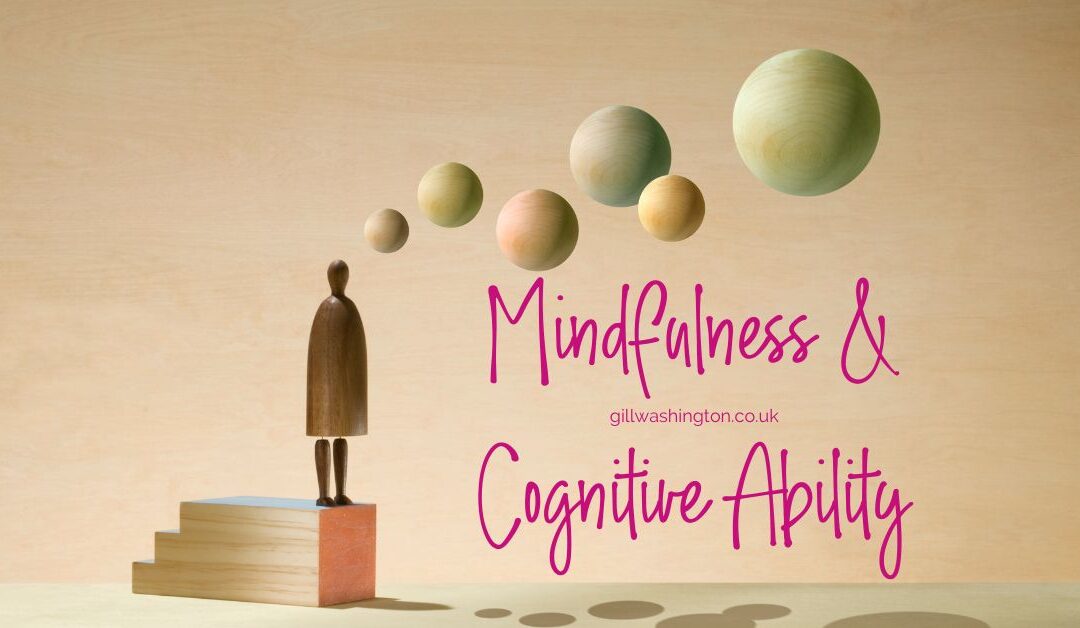
Mindfulness and Cognitive Ability
Studies have shown that even brief periods of mindfulness training can help increase cognitive ability. Additionally it can lead to a decrease in cognitive decline from aging. Studies looking at mindfulness and prevention of Alzheimer’s are promising.
According to an article on nih.gov:
“Recent research on MBI and aging show positive effects on cognitive, emotional, and psychological domains. There is preliminary evidence that mindful meditation may improve attention, memory, executive function, processing speed, and general cognition”.
The article goes on to state:
“meditation influences brain structure and function, particularly in areas involved in attentional control, self-awareness, and emotion-regulation”.
Mindfulness Training
Mindfulness training helps to focus attention non-judgmentally on the present moment. This greatly reduces the focus on negative thoughts. Ruminating on ‘worst case scenarios’ is therefore reduced. This can lead to less stress ( see this post on mindfulness and stress) and lower blood pressure, and much improved sleep and mood. All of these have a beneficial effect on cognitive ability. They can also reduce the risk of developing Alzheimer’s.
Multiple studies have shown meditation boosts mental clarity, stabilises emotions, increases creativity and improves focus. All of these things can decline in an aging population.
A few simple tips for life: feet on the ground, head to the skies, heart open…quiet mind.
– Rasheed Ogunlaru
Focus On The Breath
Discussing the simple exercise of just focusing on the breath for ten minutes per day, an article on the conversation.com states:
“It is curious that simply focusing on the breath in a balanced way can have such an effect on concentration and working memory. We think this is happening because meditation is a form of brain network training, where the same brain networks are repeatedly activated and so become more efficient. It seems that this form of meditation targets core brain networks, interconnected areas of the brain that work together and play a key role in many cognitive tasks.”
Mindfulness and meditation can both be practiced at home, for free or very inexpensively. It also has little chance of side effects, therefore it is well worth trying.
There are so many resources online, local groups to try, books to read and guided meditations. You have little to lose and much to gain.
Gill Washington does not provide medical advice, diagnosis or treatment. See additional information

by Gill Washington | Aug 8, 2022 | Mindfulness Practice, Month Of Mindfulness
Mindfulness And Chronic Pain
This is the eighth of a 15 part series of A Month of Mindfulness Posts.
Studies have shown that mindfulness can help with chronic pain and my own experience bears this out. I have arthritis in my right hand, and have used mindfulness meditation to improve this. I have also taken the eight week Mindfulness Based Stress Reduction programme quoted in the mindful.org article quoted below.
If you want to take a look at some of the studies, have a read of this article on NIH website.
In the previous post in this series, Mindfulness And Immune Response, we looked at how stress can raise cortisol levels. A regular mindfulness practice will help to lower these levels.
Lowered chronic stress levels can reduce levels of inflammation, which can reduce the risk for many diseases including heart attack, stroke and cancers, as well as lowering chronic pain.
Mindfulness Based Stress Reduction
This is from an article on Mindful.org:
“Jon Kabat-Zinn, the pioneer who brought mindfulness to the West as a possible psychological intervention, was the first to study the connection between mindfulness meditation and pain. In his 1985 study, 90 chronic pain patients were trained in Mindfulness-Based Stress Reduction (MBSR). Results indicated statistically significant reductions in measures of present-moment pain, negative body image, inhibition of activity by pain, mood disturbance, and psychological symptomatology, including anxiety and depression. Additionally, pain-related drug utilization was reduced. Since that study, there have been many more with similar findings”.
Not A Quick Fix
This isn’t a quick fix. You won’t get instant relief from chronic pain with a few minutes of meditation every now and again. But taking the time to learn about the stress response and how to lower it can certainly help. As can learning to pay attention to the mind and body with mindfulness exercises.
When pain is chronic, there can be a tendency to worry and fret about it. Mindfulness exercises can help to focus the mind, in a non-judgmental way, which can lead to less focus on the pain. Jon Kabat-Zinn speaks of how our thoughts around the pain are not pain. Such thoughts as ‘this is killing me’, ‘this is ruining my life’ can add to the suffering. So we can learn to distinguish between the pain sensation itself and the total suffering.
When we can learn to accept the pain, rather than resisting it, that itself may cause a reduction in pain.
The Mindfulness Based Stress Reduction book and workbook are available to buy, and if you are suffering with chronic pain they could be well worth investing in. Or if you can find an eight week course available locally, take a look into that.
Body Scan
A body scan can be particularly helpful for dealing with pain. This one from Jon Kabbat-Zinn on YouTube is excellent: Body Scan Meditation
Whether you choose to focus on your breath, do a body scan, or work through the MBSR programme, I am sure you will find mindfulness helpful in reducing your chronic pain.
Gill Washington does not provide medical advice, diagnosis or treatment. See additional information

by Gill Washington | Aug 2, 2022 | Mindfulness Practice, Month Of Mindfulness
This is the seventh of a 15 part series of mindfulness posts. One will be posted every other day for 30 days, so keep checking back.
Chronic Stress And The Immune System
Studies have shown that chronic stress can have a negative effect on the immune system. Check out this post about mindfulness and stress
Stress is useful, and we will always have some level of stress. But so often today many of us are in the fight or flight response way more often than is helpful. Adrenaline and cortisol are the two main stress hormones, that flood the body when we are under stress. Helpful in the short term, and ideally levels return to normal when the threat has passed.
You can read more about the effects of chronic stress and how it affects health in this article by the Mayo Clinic
A regular mindfulness practice has been shown to induce relaxation and lower stress levels.
When we are relaxed, our body and mind both have the opportunity to renew and repair. We calm down our system responses (for example overactive adrenal response) and our immune system is able to operate at full capacity.
We will be much less likely to suffer from colds and flu when relaxed. These illnesses are often the body’s way of slowing us down. You can read more about stress and illness here
Just Breathe
I will breathe. I will think of solutions, I will not let my worry control me. I will not let my stress level break me. I will simply breathe. And it will be okay.
– Shayne McClendon
The quickest and easiest way to immediately calm your stress responses down is to breathe slowly and deeply. Just concentrate on your breath. Counting the breaths, or saying in, out on the inhale and exhale can help to focus your mind.
Deep breathing can help to alleviate stress and anxiety, and you can do it anywhere, anytime.
Sit, stand or lie quietly. Place your hands gently on your abdomen. Take a deep breath in through your nose counting to four and feel it fill your abdomen. Hold it for the count of two. Breathe out through your nose to the count of four, and feel your abdomen deflate. Exhale as fully as possible. Repeat twice more.
There are more breathing exercises you can do, and different counts you can work with, but this is a good one to get started.
Three Minute Breathing Space
Another quick and simple but very effective exercise to do is a three minute breathing space meditation. I have recorded one for you, and you can download it here
You can also just set a timer for three minutes and follow your breath or create your own meditation. When you find your mind has wandered, just bring it back to the breath.
Music And Self-Hypnosis
Turn up the volume close your eyes and let the music take over your soul.
– unknown
It is proven that listening to relaxing music for thirty minutes per day can really help to boost our mood. It can lower our blood pressure and relieve anxiety, stress, and depression. Give it a go and see if it helps.
YouTube has some great videos, and you can search for whatever your main problem is. I love to combine listening to the relaxing music with self-hypnosis. Jason Stephenson is one of my favourites, and I often fall asleep listening to one of his meditations.
There are some ideas above to get you started reducing your stress and boosting your immune system. Taking just a few minutes per day to try them can really make a difference.
Gill Washington does not provide medical advice, diagnosis or treatment. See additional information
by Gill Washington | Jul 31, 2022 | Mindfulness Practice, Mindset
Can mindfulness help with sleep? Why no try it and find out.
This is the sixth of a 15 part series of mindfulness posts. One will be posted every other day for 30 days, so keep checking back.
A very common problem I come across when talking to clients and friends, and when looking at social media, is a chronic lack of sleep. There are frequent references to ‘the 3am club’. This seems to increase as people are over 50, but can affect anyone.
I have myself suffered with insomnia. Having made some adjustments to my lifestyle and bedtime routine I have gone from getting between four and five hours sleep per night to between six and seven hours. Some nights I even mange over eight hours. My average now is seven hours per night, and I feel so much better for it. Mindfulness meditation has been a huge part of this.
Long Term Health And Wellbeing
Sleep is immensely important to our long term health and well being. A lack of sleep can cause many health problems, including anxiety, depression, heart disease, obesity and diabetes. It is therefore extremely important to do all we can to increase the amount and quality of sleep we get if we are not getting the recommended 7 – 9 hours of sleep per night.
How Can Mindfulness Help?
Mindfulness meditation and other mindfulness practices induce a sense of wellbeing and relaxation. When you are stressed and tense, the likelihood is you will find it difficult to fall asleep. Then, when you do get to sleep it is likely to be restless and disturbed. Just 5 minutes of meditation per day can help to bring about a more relaxed state.
Meditation Before Sleep
If I don’t do any other meditation in a day, I always do a few minutes when I first wake up (before I even open my eyes), and last thing at night before going to sleep. These are two really valuable times to meditate. The veil between the conscious and the subconscious mind is lifted, and insights can easily pop up. Agitated thoughts can calm down, and heart rate and blood pressure can lower.
I prefer to just follow my breath for the early morning meditation, as I don’t want to open my eyes or look at my phone and break that wonderful half awake, half asleep, state. If you prefer, or if you find it difficult to just follow your breath, you can listen to a guided meditation.
There is a three minute breathing space meditation you can download for free here.
There are also lots of videos you can listen to on YouTube and other places online. Find a voice that is restful for you. You don’t want an annoying voice disturbing your relaxation. I always listen to a minute or two before downloading.
If you would like to get one to one help from me with your meditation, consider booking a power hour with me. You can read more about how it works here: gillwashington.co.uk/power-hour
During a meditation power hour, as well as working through your pressing issue, we will do some meditation together.
If you’re struggling with getting to sleep, staying or sleep, or poor quality of sleep, why not just try a couple of minutes at the start and end of your day. Keep a journal if possible of any insights and feelings that pop up, and keep going for 21 days. Then compare your thoughts and feelings from day one, with day twenty one. I’m sure you will have noticed an improvement in your sleep, and other areas of your life too.
Mindfulness For Busy People
Check out my 21 day email course Mindfulness For Busy People if you would like to get started with a mindfulness practice but always feel like you don’t have time or don’t know where to start.
Happy Meditating!
Gill Washington does not provide medical advice, diagnosis or treatment. See additional information

Recent Comments